
TCP/IP stands for Transmission Control Protocol/Internet Protocol, which is a set of networking protocols that allows two or more computers to communicate. The Defense Data Network, part of the Department of Defense, developed TCP/IP, and it has since then been widely adopted as a networking standard.
Unlike the OSI model, the TCP/IP model is not an international standard and its definitions vary.
Nevertheless, it is often used as a pragmatic model for understanding and troubleshooting Internet networks.
The vast majority of the Internet uses TCP/IP, and so we can make some assumptions about networks that make them easier to understand.
Basically in the TCP/IP model the top 3 layers (Session, Presentation and Application) of the OSI model is combined into one layer (Application) in the TCP/IP model.
Then the Networking Layer as called in the OSI model is renamed to Internet Layer in the TCP/IP model.
The TCP/IP model of networking describes the following five layers:
| 5 | Application |
| 4 | Transport |
| 3 | Internet |
| 2 | Datalink |
| 1 | Physical |
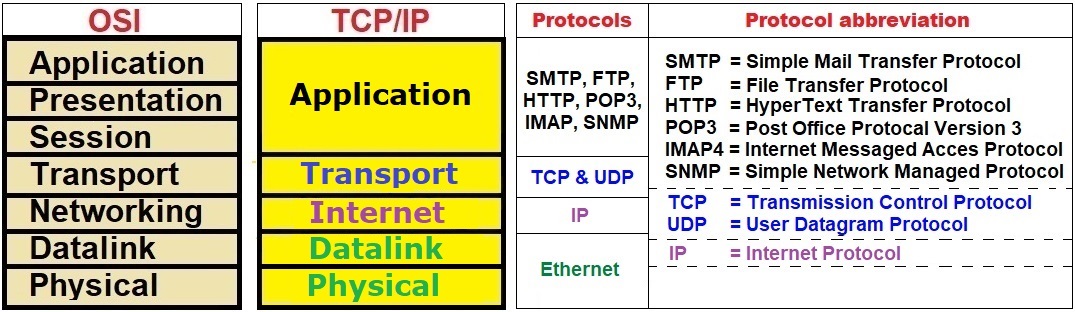
The first four layers in both models are identical.
The only difference is that Layer 3 is called in the OSI model “Network” but in the TCP/IP model it is called “Internet”.
Many network engineers think of everything above layer four as “just data” that varies from application to application.
Since the first three layers are interoperable between virtually all manufacturers’ equipment, and layer four works between all hosts using TCP/IP, and everything above layer four tends to apply to specific applications, this simplified model works well when building and troubleshooting TCP/IP networks.
(We will use the TCP/IP model when discussing networks and the internet on this site.)
The TCP/IP model can be compared to a person delivering a letter to a downtown office building.
The person first needs to interact with the road itself (the Physical layer), pay attention to other traffic on the road (the Data Link layer), turn at the proper place to connect to other roads and arrive at the correct address (the Internet layer), go to the proper floor and room number (the Transport layer), and finally give it to a receptionist who can take the letter from there (the Application layer).
Once the message is delivered to the receptionist, the delivery person is free to go on his way.